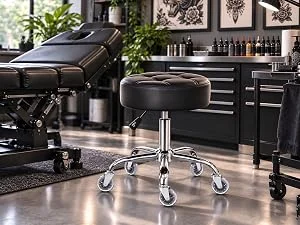
Tattooing is a physically demanding job. Artists spend hours leaning forward, twisting their torso and holding a steady hand while their spine stays locked in an unnatural position. An ergonomic saddle stool for tattoo artists solves a big part of that problem: it lets you sit higher than a standard chair, keeps your hips above your knees, brings you closer to the client and reduces the fatigue that builds up over a long session.

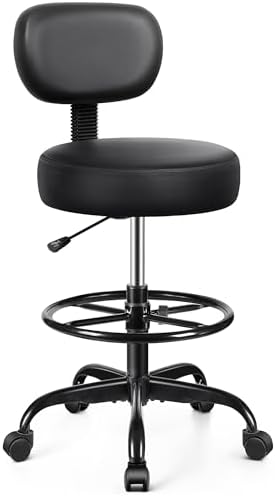
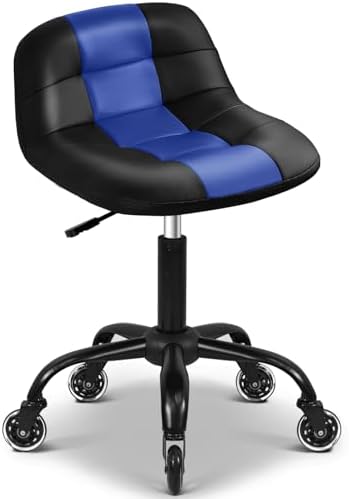
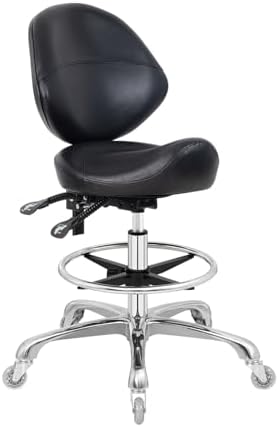
This guide explains how these stools work, what features actually matter in a studio, how to choose the right height and base, and the mistakes that make an otherwise good stool uncomfortable after two hours of work. The reference model used throughout is a rolling, height-adjustable saddle stool with a thick wide seat pad and hydraulic lift, a design that has become standard in tattoo studios, clinics, spas and beauty salons.
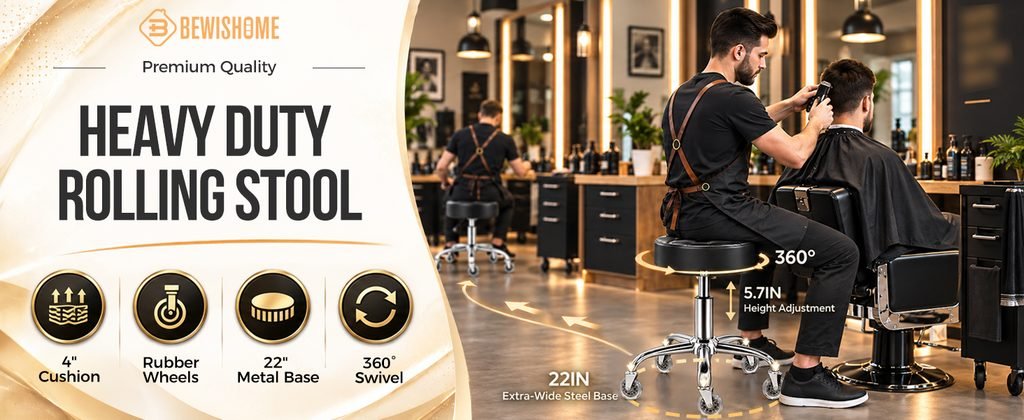
What an ergonomic saddle stool actually is
A saddle stool is a seat shaped roughly like a horse saddle rather than a flat square cushion. The shape splits the load between the two sitting bones (ischial tuberosities) and supports the inner thighs, which encourages a forward-tilted pelvis and a naturally straighter lumbar curve.
The seating position it creates is called declined or elevated seating: the seat pan is slightly tilted forward, and the hips sit higher than the knees. Unlike a conventional chair, which flattens the thighs and rounds the lower back, this position keeps the pelvis neutral and lets the spine hold its natural S-curve without muscular effort.
In a tattoo studio, that translates into three practical effects:
- You sit closer to the client’s skin, so you stop over-reaching with your arms and shoulders.
- Your upper arms stay near the torso and your forearms stay roughly parallel to the floor, which reduces strain on the neck and shoulders.
- You can shift your weight and rotate the hips during long sessions instead of freezing in one posture.
Ergonomic seating specialists describe this as “standing while sitting”: the body gets part of the benefit of standing posture — better alignment, more core activation — without the fatigue of staying on your feet all day.

Why tattoo artists specifically benefit
Tattoo work concentrates static load on the cervical and lumbar spine. The artist’s head tips down, the shoulders round forward and the low back is often flexed for hours. Add precision work under magnification and the muscular tension multiplies.
A well-adjusted saddle stool changes the geometry of the workstation:
- Less forward lean. Because you sit higher and closer, the torso stays more upright and the neck flexes less.
- Shorter reach. The client platform and your tray sit within a comfortable radius, so the shoulders stay relaxed instead of climbing toward the ears.
- Active sitting. The saddle shape forces constant micro-adjustments of the hips and core, which keeps circulation going and reduces the stiffness that comes from static sitting.
- Faster repositioning. With a swivel seat and smooth casters, you move around the client’s arm, leg or back without standing up and breaking concentration.
Some ergonomics sources report that active-sitting saddle chairs can reduce lower back strain substantially compared with conventional seating, though exact figures vary by study and by how well the chair is fitted. The takeaway is qualitative but consistent: posture improves when the seat matches the task.
Key features to check before buying
Height adjustment range and hydraulic lift
Tattoo work happens at very different levels: a forearm piece, an ankle piece, a full back piece. A gas or hydraulic lift with a lever under the seat lets you change height in seconds with one hand. Check the minimum and maximum seat height against your own body and your client’s setup — a stool that is too low forces you back into the hunched posture you are trying to avoid.
A practical rule: when seated, your forearms should rest roughly parallel to the floor while your hands work at the client’s skin level.
Saddle seat shape and padding
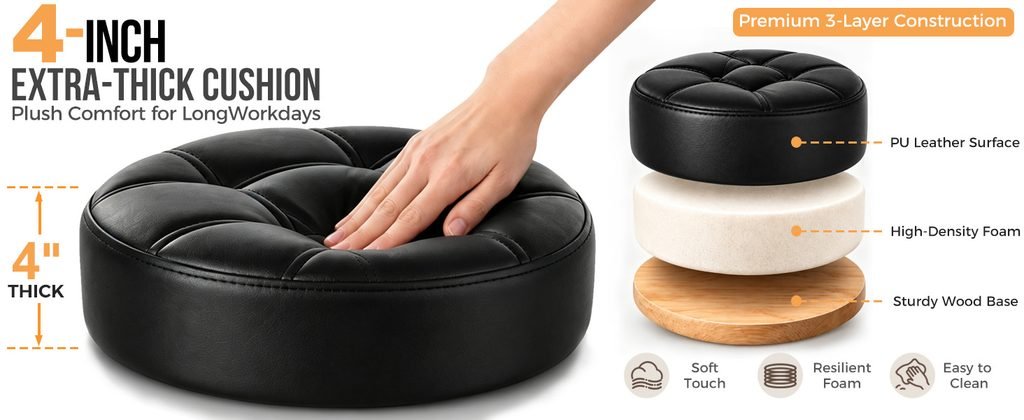
Look for a thick, wide saddle pad with a slight center channel. The channel relieves pressure on the perineum and soft tissue, which matters when you sit for four-hour sessions. Very thin padding feels fine for ten minutes and painful after an hour; overly soft foam bottoms out and creates pressure points. High-density foam covered in easy-to-clean synthetic leather or PU is the usual professional compromise.
Base, casters and stability
A five-star base distributes weight and resists tipping when you lean to one side. Twin-wheel casters roll smoothly over studio flooring; soft or PU wheels are quieter and kinder to hardwood and vinyl. If your station has a floor mat, check that the casters do not sink or snag on the edges.
Also confirm the stated weight capacity and that the base has a wide footprint relative to the seat height. Raising a stool increases the tipping moment, so a narrow base plus a fully extended lift is a bad combination.
Swivel and lock options
A 360-degree swivel is essential for moving around the client. Some models add a locking mechanism so the seat stays fixed when you need maximum precision. If you work on a slightly sloped floor, brakes on the casters are a plus.
Materials and cleaning
Studios deal with ink, spray, blood-borne pathogen protocols and frequent disinfection. Smooth, non-porous upholstery that tolerates alcohol-based wipes is far more practical than fabric. Check that seams are sealed and that the base finish does not chip easily.
How to set up the stool correctly
Buying the right stool is half the job; setting it up is the other half.
- Set the height first. Sit down, place your hands at working height and adjust until your elbows sit near a 90-degree angle and your shoulders drop.
- Check knee angle. Your knees should be slightly lower than your hips, with feet flat or resting on the base ring if the model has one.
- Adjust the client’s position to you. Raise or lower the client’s bed or chair so you are not reaching down or leaning over.
- Move the tray and lamp. Everything you touch regularly should be within a short arc; reaching is what turns a good stool into a backache.
- Take micro-breaks. Even ideal seating does not offset three unbroken hours. Stand up, stretch the hip flexors and roll the shoulders every 45 to 60 minutes.
Common mistakes when choosing a saddle stool
- Buying purely on price. Cheap gas lifts lose pressure and start sinking within months, which quietly destroys the posture benefit.
- Choosing a seat that is too narrow. A saddle that does not support the inner thighs feels unstable and pushes you into a tense, gripping posture.
- Ignoring the base width. Lightweight bases with small footprints are risky at maximum height.
- Skipping the trial period. Sit on it for at least twenty minutes before committing; discomfort shows up slowly.
- Expecting instant relief. Saddle seating uses different muscles. A short adaptation period of a few days to a couple of weeks is normal, and if pain worsens, the height or seat shape is probably wrong.
- Forgetting floor type. Hard casters on a delicate floor, or soft casters on thick carpet, both cause problems.
Saddle stool vs. standard tattoo chair vs. standing
| Option | Strength | Limitation |
|---|---|---|
| Standard office-style chair | Familiar, backrest support | Encourages slouching and long reaches |
| Saddle stool | Upright posture, close working distance, mobility | Requires adaptation, less back support |
| Standing all day | Maximum freedom of movement | Fatigue, leg and foot strain, harder for fine detail |
For most artists, the saddle stool is the best compromise: it keeps the spine closer to a standing alignment while removing the load from the legs. Some artists alternate between a saddle stool for detail work and standing for large fills.
Who else uses this type of stool
The same rolling, height-adjustable saddle design is widely used in:
- Tattoo and piercing studios — close access to the client and rapid repositioning.
- Massage and physiotherapy — low seats for working on tables and mats.
- Dental and medical clinics — hygiene-friendly upholstery and precise height control.
- Beauty salons and nail studios — long shifts at a fixed workstation.
- Workshops and repair benches — electronics, guitar repair, watchmaking and similar precision tasks.
That versatility is why manufacturers market these stools as “massage medical stools” rather than tattoo-specific products. The requirements, however, are the same: adjustable height, a stable base, a supportive saddle pad and easy cleaning.
Conclusion
An ergonomic saddle stool for tattoo artists is not a luxury accessory; it is a tool that protects the hands, neck and back you depend on for your income. Prioritize a hydraulic height adjustment with enough range, a thick saddle pad with a center relief channel, a five-star base with quality casters and upholstery you can disinfect. Then spend ten minutes setting the height and the client’s position correctly — that is where most of the benefit is won or lost.
Frequently asked questions
Is a saddle stool better than a normal chair for tattooing?
For most artists, yes. It keeps the hips higher than the knees, brings you closer to the client and reduces forward leaning. It does require a short adaptation period and offers less backrest support, so it works best combined with regular breaks.
What height should a tattoo stool be?
It depends on your body and your client’s setup. A practical reference is that your forearms should be roughly parallel to the floor with your hands at working height, and your knees slightly below your hips. Choose a stool whose adjustment range covers that position comfortably.
Do saddle stools help with back pain?
They support a neutral lumbar curve and reduce static flexion, which many artists find helpful. They are not a medical treatment; if pain persists or worsens, consult a health professional and review your whole workstation, not just the seat.
Are the wheels safe on studio floors?
Twin-wheel casters are generally safe on hard floors and low-pile carpet. Choose soft PU wheels for wood or vinyl, and consider caster brakes if your floor is sloped.
Can I use a saddle stool for massage or clinical work?
Yes. The same rolling, height-adjustable design is standard in massage, physiotherapy and dental settings. Just make sure the upholstery is non-porous and compatible with the disinfectants your workplace uses.
FUENTES EXTERNAS:
- Amazon — BEWISHOME Rolling Adjustable Massage/Medical Saddle Stool (product listing and specifications)
- SitHealthier — “Why Saddle Chairs Are the Unsung Hero of the Tattoo Studio”
- RDH Magazine — “You’ve got a saddle seat. But how does it work?”
- RehabMart — Treatment and rolling stool category reference